
Grow with demand. Keep the budget accountable.
Upton’s retail-channel revenue grew 16.3% across January–October 2026, with marketing efficiency up 11.6%. A stronger August–October period shows why budget decisions belong alongside product demand and availability.
Focus
Paid media strategy and performance review
Platforms
Meta, Google & Shopify
Retail revenue growth
Aggregate MER

More growth from a measured increase in spend
Upton · January–October 2026 · Compared with the same months in 2025
For a design-led home goods brand, demand does not arrive on a perfectly predictable schedule. A product comes back into stock. A new collection gives customers a reason to return. A bestseller starts selling faster than the next shipment can arrive.
That makes the advertising decision more useful—and more demanding—than simply choosing a larger budget. The question is where additional investment makes sense for the business.
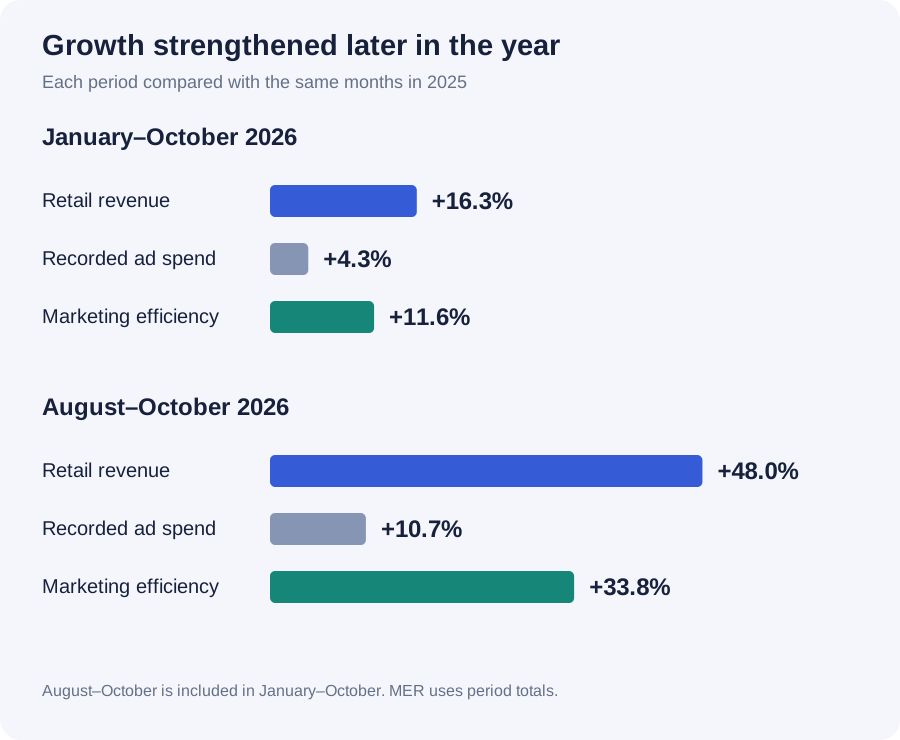
Across January–October 2026, Upton’s selected Shopify retail-channel revenue grew 16.3% year over year. Recorded Meta and Google spend increased 4.3%, while marketing efficiency ratio (MER) improved 11.6%.
The later part of the reporting window was stronger. Across August–October, revenue grew 48.0% against a 10.7% increase in recorded media spend. Aggregate MER improved 33.8%.
The year was not a straight climb
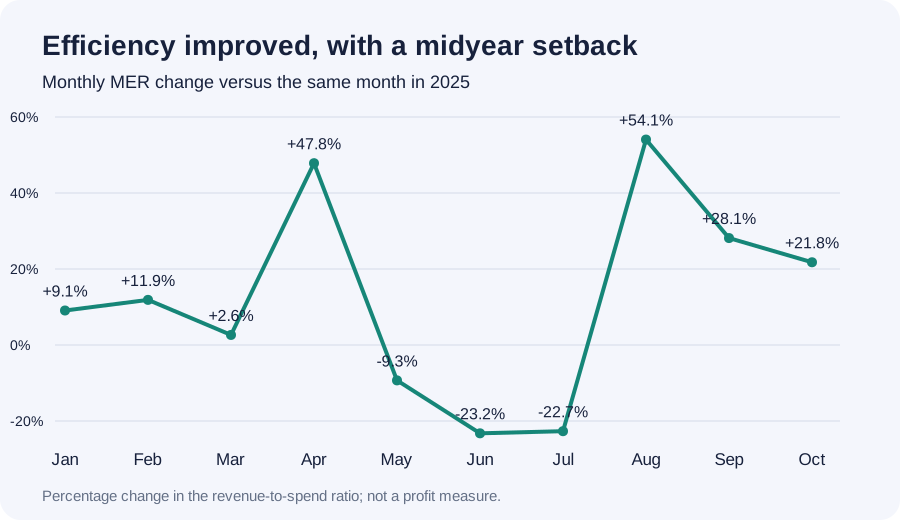
The broader comparison matters. Across January–July, retail revenue grew 1.8%, recorded spend grew 1.1%, and aggregate MER improved 0.7%. May through July brought weaker year-over-year revenue and efficiency comparisons. The later gains followed that softer period; they were not the pattern throughout the entire year.
In August–October, each month recorded higher retail revenue and higher MER than the same month a year earlier. The opportunity was to support that stronger demand while continuing to evaluate the investment behind it.
Let performance and availability guide the next decision
Give the budget a business-level check
Morpheus Media and Upton reviewed store revenue alongside Meta and Google performance. This connected the advertising conversation to a practical question: was the business generating more revenue relative to its recorded media investment?
In the November review of October results, the team discussed why spending had increased. The explanation was performance-led: the larger investment was being evaluated against revenue and efficiency, with MER reviewed regularly to inform adjustments. That review supports the decision process described here; it does not isolate the effect of an individual budget change.
Keep product availability in the conversation
During the September review, stock availability was a central concern ahead of the holiday period. The discussion connected efficient spending with the ability to meet demand, rather than treating the media budget as a target that had to be exhausted.
In the later review, Upton linked August’s stronger trading to products coming back into stock. That context matters. Restocks can release existing demand and improve the response to advertising. The August result should not be presented as the effect of a campaign change alone.
Separate retail performance from other sales channels
Upton also sells through channels beyond its online retail storefront. Looking only at total Shopify sales would give a different growth picture.
The results in this case consistently use Online Store, Shop, and Facebook & Instagram revenue in both years. Faire wholesale, Draft Orders and other channels are excluded. That gives the retail comparison a consistent basis without folding wholesale growth into the headline.
Jason Heiber and the Morpheus Media team’s role in these reviews was to keep those views connected: the channel reports, the retail result, and the products the business could actually supply.
A stronger later period, with the longer trend in view
January–October: revenue grew faster than investment
Retail revenue increased 16.3%, recorded Meta and Google spend increased 4.3%, and aggregate MER improved 11.6%. The result covers all completed months of 2026 through October, including the weaker midyear stretch.
August–October: stronger growth with better efficiency
In this later period, retail revenue increased 48.0% while recorded spend increased 10.7%. Aggregate MER improved 33.8%. The business generated more retail revenue per unit of recorded advertising investment than in the same period a year earlier.
MER here means selected retail revenue divided by recorded Meta and Google spend. Period comparisons use summed revenue and spend, not an average of monthly percentages. This is an efficiency result, not a measurement of profit or incremental advertising lift.
The practical lesson for a growing brand
A useful growth review asks more than whether an ad account is performing. It asks whether the revenue comparison is consistent, whether products are available, and whether the next increase in investment is supported by the business result.
Upton’s 2026 results show why those questions belong together. Growth strengthened later in the year, while the full-period comparison still showed higher revenue and better marketing efficiency.
Make your next budget decision with a clearer view
Talk with Jason Heiber and Morpheus Media about connecting paid media, product demand and store-level performance.
FREE AUDIT
Request a FREE audit within your industry to find out how fast we could potentially grow your company's sales and profits.
Don't take our word for it, take theirs!
We understand your requirements and deliver growth, no fluff.

Matthew Rosenfeld

Stephen Murphy

Elizabeth Grojean
“Amazing experience with Jason and his team. They are absolutely experts in terms of paid social advertising and paid search. They helped us build out amazing landing pages and drove phenomenal results for our brands. Couldn't recommend them more highly. If you want to drive results - go with Jason and the Digital Marketing NYC team.”
Matthew Rosenfeld
“Personalized service from experts in the field and spot on performance under pressure. They have been helpful in identifying how to convert business in the digital landscape for financial services.”
Stephen Murphy
“Our company has worked with Jason for several months - we've seen amazing results in ads with up to 78x ROAS (even, 100x ROAS, which seems hard to believe but is true). He's knowledgeable about all facets of digital marketing and how they complement each other, e.g TOF, MOF and BOF, including SEO and email, and stays up to date on best practices. Unlike other agencies this team has been truly collaborative and interested in understanding our business on a deep level. Ten stars.”
Elizabeth Grojean
Ready to claim your digital real estate?
Paid ads are the fastest way to grow your company and to get in-front of your competition. Get a quote today!


Browse our Packages
Find out if Google Ads or Social Media Ads are best to start your journey.
Browse Packages